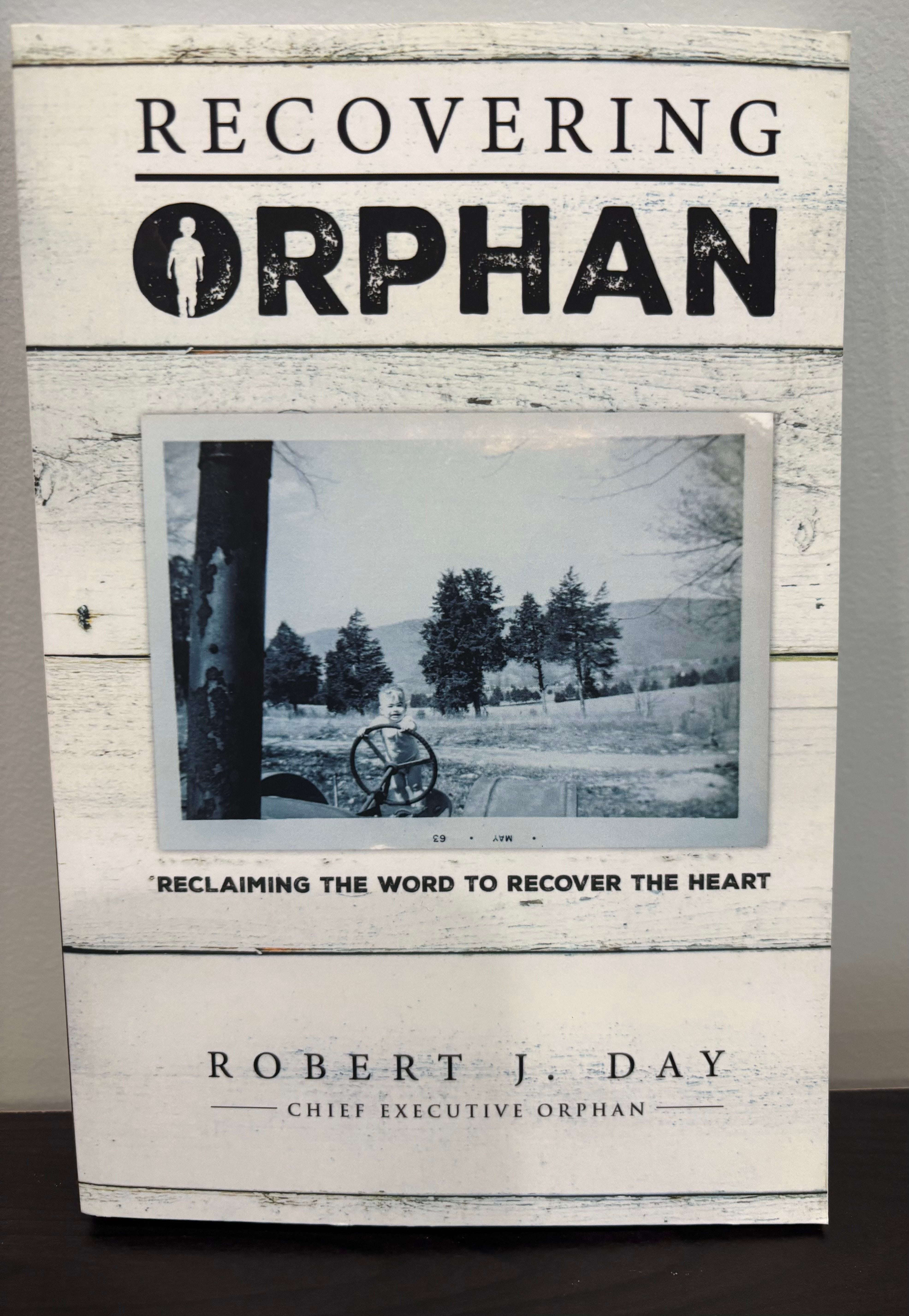
“Hi, everyone. My name is Robert Day. I am a 63-year-old recovering orphan. I’ve gone twelve days without feeling rejected, lonely, or unloved.”
If this was a meeting of Orphans Anonymous, or OA, this is where you would say, “Welcome, Robert!” Of course, there’s no such thing as OA, but with as many anonymous orphans as we currently have in this world, perhaps there should be.
I was born an orphan; I grew up an orphan. In fact, I was the first child of fifteen orphans born to my two parents, who also were orphans. Throughout my childhood, I was treated as an orphan. I spent time in foster care and was rejected by my birth parents over and over again.
A parent’s rejection is probably the deepest and longest-lasting wound a child can suffer. Boy, did my mother do a number on me! Her lifetime of serial rejection—from my birth to her death—defrauded me of something most people take for granted: to live securely in the knowledge that your parents love you and have your back. My father is guilty as well, maybe more so, but for some reason my mother’s rejection hurt a whole lot more.
Thus, I have lived a good portion of my adult life carrying the wounds of an orphan. Though there has been substantial healing along the way, I still occasionally struggle to vanquish the natural consequences of my orphan injuries. In many ways, I still have an orphan spirit: feeling, among other ways, abandoned, angry, fearful, hopeless, worthless, mistrusting, and manipulated.
“But wait!” you might say. “You had two parents. How can you be an orphan?” It’s true, the word “orphan” conjures up images of children in uniforms, marching in lines, eating gruel in dank, dark Victorian or Great Depression-era orphanages. Like Oliver or Annie, but without the singing. Orphans are children whose parents die in war or of famine or plague, or children left by roadsides with a note pinned to their chests. It’s true, there was a time in this country when orphans were easily identifiable, carrying their shame like a badge. There also was little doubt or debate that these children needed services and care. Nor was it ever questioned that the Church—the Body of Christ—should take an active role in their care. Those once-visible orphans have been replaced by invisible ones.
Here’s the truth: Not every orphan is an orphan. And not everyone who is an orphan realizes they are one. Let me explain.
First and foremost, we must understand that the main issue at hand is vulnerability. A child, by nature, is vulnerable. Children who are missing parents—for whatever reason—experience another level of vulnerability altogether. Children come into the world, the procreation of two people—a man and a woman, a mother and a father—and are raised by a member of both sexes. They learn from and can, thereby, relate to both, as well as be blessed by both. That’s the ideal situation. Of course, not every child has the ideal situation.
Think of it like this: Growing up without one of your parents is like missing an arm or a leg. It doesn’t make you less of a person, but it does make it harder to navigate certain aspects of life without help.
Using three sources of authority, Orphan is defined here to be a minor child missing one or both parents.
The Bible—In the Scriptures, the words “orphan” and “fatherless” are interchangeable, meaning a child only needs the loss of one parent to be an orphan.
Orphanages—Children in these institutions were called orphans. Sometimes they were recorded as half-orphans or double orphans—even by state officials—in order to distinguish how many parents were absent. Approximately 85–95 percent of all children in the history of the orphan asylum movement had at least one living parent, usually the mother. From a biblical perspective, they were fatherless children.
UNICEF—An arm of the United Nations and their global partners, UNICEF has a similar system to that of the old orphanages. It defines an orphan as a child under 18 years of age who has lost one or both parents to any cause of death: Maternal orphan, a child whose mother has died. Paternal orphan, a child whose father has died. Double orphan, a child who has lost both parents.
So, what are the circumstances that make a child an orphan? UNICEF includes only death in their definition, but because vulnerability is at the center of our concern, we expand the causes to include nearly any circumstance where at least one parent is not involved in the life of the child. They include the seven D’s:
Death—self-explanatory
Desertion—abandonment
Dissolution—parental rights terminated
Detainment—long-term incarceration
Disappearance—whereabouts unknown
Disaffection—estrangement, alienation, apathy
Dysfunction—family impairment that results in neglect, abuse, or exploitation
The orphan spirit doesn’t care about what makes a child an orphan—legal, official, or otherwise. In fact, I would argue that a child who is missing a parent because of death—as terribly hard as that can be—is potentially in a better place emotionally than a child who has a living parent who is absent, or worse still, present and abusive. A child rejected by a living parent is deeply wounded in ways that a child who loses a parent by death is not.
Once you are open to this more-inclusive definition, you will suddenly see orphans everywhere. I venture to say there are more orphans in America today than we’ve ever had in our history, even during periods of war, disease, and economic turmoil.
Now that you’ve taken the first, crucial step in understanding who, or what, is an orphan, let’s define a widow.
Like an orphan, a widow has become narrowly defined. It most commonly refers to an older woman whose husband has died. Certainly, those women should be seen and served as those who are vulnerable. However, in the Bible the word widow is almost always associated with the word orphan.
Remember, vulnerability is the concern of God in these verses. If a spouse has died, the surviving spouse is a widow, or if male, a widower. If this happens while their children are still young, we would call them orphans, and the Christian community would rightly rally around them.
Now, let’s expand the concept a little further. If a person—usually a woman—is the parent of an orphan, wouldn’t that make her a widow? This may be a bit more difficult to comprehend, or perhaps to accept, but it’s exactly why orphanages failed to properly serve the orphaned. They gladly received children into their institution, whose fathers were absent for whatever reason, but often did little to help the mothers. Their narrow definition overlooked the full will of God in those situations. If they had helped the widow—we call them single mothers today—her orphan children would automatically be the beneficiary of that help too. By serving only the orphan, orphanages neglected the most important need of their residents: family. If we can accept the broader and more historical definition of orphan, for practical reasons alone, we must then embrace the more inclusive definition of widow as well. It’s the very best way to help both.
OK, is your brain tired yet? Well, we can’t stop here. There’s one more thing to consider—one more step we need to take in our quest to grasp the full boundaries of the orphan universe.
If a child who grows up without a parent is an orphan, that doesn’t necessarily change once they become legal adults. For the rest of their lives, they will never have that parent. Yet, they’ll always carry the wound—an inner vulnerability, if you will. In other words, the limb is permanently missing. I call these adults “recovering orphans,” and like a recovering addict, no matter how old they become or how much healing they enjoy, they’re only a situation, a temptation, or a circumstance away from giving in to the old spirits of orphanhood.
The issue is no longer just about the vulnerability of a minor, but also the volatility of an adult. Consider it from these two different perspectives—the two sides of the orphan coin.
The orphaned child is a vulnerable victim, living in a world of volatile adult villains.
The recovering orphan is a volatile villain, living in a world full of vulnerable victims.
This book is my story of being both—victim and villain—and many of the painful lessons I learned along the way to healing and reconciliation. My goal is twofold: to help recovering orphans find their purpose and healing and to equip the saints for the work of the ministry to orphans and their mothers—or fathers, as the case may be.